for hospitals & NICUs
A donor milk partner your NICU can count on, order after order.
The evidence for an exclusive human milk diet is well established. The harder question is whether your supplier is a partner in infant health or just another vendor. Can they consistently fill every order, every time. Since 2005 The Milk Bank has, with a 100% fill rate across all patient populations and 125 hospital units in 13 states. The Milk Bank is also the primary nonprofit milk bank for Indiana, Kentucky and Missouri.
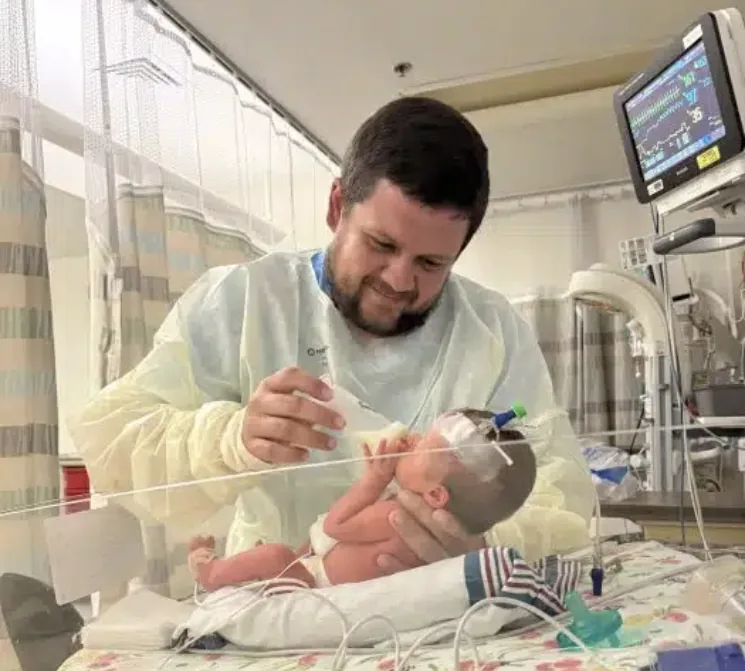
$11 saved for every $1 spent
A reduction in length of stay, NEC and sepsis may result in a relative saving of approximately $11 to the NICU or health plan for each $1 spent on pasteurized donor human milk. (Wight, N.E. J Perinatol. 2001; 21:249-254.)
the clinical case
Human milk saves lives, and the evidence is well established.
Necrotizing enterocolitis (NEC) remains the leading cause of death in hospitalized premature infants after the first two weeks of life. NEC is multifactorial, and its exact mechanisms, timing, and triggers are still not fully understood. Established risk factors include extreme prematurity, very low birth weight (<1500 g), severe anemia, and the absence of human milk.
While no intervention can eliminate NEC risk, mother’s own milk provides the strongest known protection, and pasteurized donor human milk is the next best option when mother’s milk is unavailable. Human milk supports immature immune and gastrointestinal systems, reduces infection risk, and is associated with lower rates of NEC and sepsis in vulnerable infants.
Clinical teams and lactation consultants play a critical role in optimizing maternal milk supply and ensuring timely access to donor milk. For infants at heightened risk of NEC, human milk—maternal or donor—can be lifesaving.
70%
of mothers with infants in the NICU are unable to provide all of their baby's milk needs.
Carroll & Herrmann, Breastfeeding Medicine (2013); American Academy of Pediatrics (2012). Clinician resources
$74k+
in added cost from a single medical NEC case, and far more if it turns surgical. See the full cost breakdown
Ganapathy et al., 2012.
1 in 10
very low birthweight babies develop NEC.
NEC Society Press Kit, 2026.


the question that rarely makes it into a contract review
Every supplier can quote a price. Can they reliably, safely, and ethically fill every order?
Hospitals can’t risk scrambling for a fragile baby's next feed. Fill rate is the metric that protects your patients, and it is the one that rarely appears in a contract comparison. What happens when a supplier runs short, and eight questions to ask any milk bank.
| What to compare | The Milk Bank | For profit, pasteurized human milk (frozen) | For profit, sterilized human milk (shelf stable) |
|---|---|---|---|
| FDA registered and subject to inspection | Yes | Yes | Yes |
| Multi-step medical screening of milk donors | Yes | Yes | Yes |
| Microbiological testing of every batch in a licensed laboratory | Yes | Yes | Yes |
| Processing that protects bioactive components (HMOs, secretory IgA, lysozyme) | Yes | Yes | No |
| Third-party audits against national milk banking guidelines | Yes | No | No |
| 100% volunteer, non-remunerated donor pool | Yes | No | No |
| Regional partner offering crisis response and bereavement care | Yes | No | No |
| Medical Relief Fund so ability to pay never dictates infant outcomes | Yes | No | No |
| Nonprofit organization prioritizing infant health and community over profit | Nonprofit, since 2005 | No | No |
Every hospital partner works with a dedicated representative from our Hospital and Patient Services Team to guide units through onboarding, ordering, Joint Commission visits, staff education and access to free resources. No minimum or exclusive commitment required, just the dedicated and responsive support your team needs.
Building the case for your value analysis committee?
Request the full Healthcare Partner Resource Kit, or download the current PDHM product page with bottle sizes, calorie options, nutritional analysis details and ordering contact information.
where hospitals use it
Donor milk is not only a NICU product.
in the NICU
Reduce mortality, cost and length of stay
For critically ill and low birthweight infants, pasteurized donor human milk is the safest alternative when mother's own milk is unavailable, and it lowers the risk of NEC, sepsis, retinopathy of prematurity and bronchopulmonary dysplasia.
in the postpartum unit
Protect breastfeeding from the first feed
The AAP, the WHO and the US Surgeon General all recommend donor milk for full-term babies, and exclusive breastfeeding rates at discharge are higher when donor milk is available for supplementation. It also helps reduce hypoglycemia, weight loss and hyperbilirubinemia. There is no minimum order size, whatever the size of your unit.
in an outpatient setting
Continue care after discharge
Donor milk supports babies with complex medical conditions after they go home, including failure to thrive, reflux, GI disorders, cardiac conditions, kidney disease, severe formula intolerance and more. Optional access to our outpatient dispensaries extends your continuum of care, and clinician resources cover ordering, handling and in-service education.
what your team can expect
Full spectrum nutritional analysis including protein and calories, offered at 20, 22 and 24 calories per ounce. Macronutrients printed on every label. A scannable QR code on each bottle for easy charting. Independent third-party lab microbiological testing on every order. No minimum orders. Orders placed before 2:30pm EST ship next day via UPS overnight, and orders are dispensed Monday through Thursday.
start the conversation
Your partner in infant health, not just your supplier.
Every hospital partner works with a dedicated representative from our Hospital and Patient Services Team to guide units through onboarding, ordering, Joint Commission visits, staff education and access to free resources. No minimum or exclusive commitment required, just the dedicated and responsive support your team needs.